Author: Improvement facts

  • The Science of Concentration: 3 Proven Ways to Train Your Brain for Deep Concentration

    In 2013, a study conducted by Microsoft revealed something surprising.

    The average human attention span—the ability to stay focused on a single task without getting distracted—had dropped to just 8 seconds.

    And the irony is even more shocking. An internet survey found that nearly 95% of people never finish reading an online article.

    Now, with such a fragile attention span, success is a distant goal. In fact, you may struggle to perform even your everyday tasks effectively.

    But here’s the good news: Improving your focus and concentration is not as difficult as most people think.

    In today’s blog, you’ll discover several unique and powerful techniques that can dramatically improve your focus, productivity, and mental discipline.

    If you apply these methods consistently in your daily life, your productivity and success graph may never look the same again.

    So, let’s get started.

    1. The Wim Hof Method

    Wim Hof is a Dutch athlete who holds 26 Guinness World Records.

    And these records are so extraordinary that they go beyond what most people—and even many scientists—once thought was possible.

    For example, in 2013, Wim Hof remained submerged in ice for an astonishing 1 hour, 53 minutes, and 2 seconds.

    And that’s just one of many incredible records he has achieved.

    According to Wim, the secret behind these extraordinary abilities is a special breathing technique known as the Wim Hof Method.

    This method has transformed the lives of millions of people, from everyday individuals to Hollywood celebrities.

    And the reason it has become so popular is simple: Not only can it improve your focus and concentration, but many practitioners also report increased energy, better stress management, and improved mental resilience.

    So let’s take a look at how this powerful method works.

    The Wim Hof Method consists of three steps:

    1. Deep Breathing
    2. Breath Retention
    3. Cold Shower

    Step 1: Deep Breathing

    The breathing technique used in the Wim Hof Method is quite different from most traditional breathing exercises.

    That’s why it should always be practiced in a safe and comfortable environment.

    To begin, sit or lie down in a comfortable position.

    Then take a deep breath in through your mouth and let it out through your mouth.

    Repeat this process for 29th breaths.

    As you do this, your body becomes highly oxygenated, which can make you feel more energized, alert, and focused.

    Step 2: Breath Retention

    On the 30th breath, inhale deeply just as you did before.

    However, after exhaling, hold your breath for as long as you comfortably can without forcing it.

    When you feel that you need to breathe again, take one deep breath in and hold it for as long as you comfortably can.

    Then slowly exhale. At this point, one complete cycle of the Wim Hof Method is finished.

    Step 3: Cold Shower

    When it comes to the benefits of cold showers, the list is almost endless.

    When our body comes into contact with cold water, a variety of chemical and physiological reactions begin to take place.

    For example, the brain starts releasing dopamine, a neurotransmitter associated with motivation, alertness, and focus.

    As a result, many people experience increased concentration and mental clarity.

    Cold exposure may also stimulate the immune system and support the body’s natural defense mechanisms.

    In addition, it can help improve resilience to stress and leave you feeling more energized throughout the day.

    If you’d like to learn more about this method in detail, you can explore Wim Hof’s online courses and training programs.

    2. Reading Boring Texts

    There is a very interesting article titled Why Wildly Successful People Choose to Embrace Boredom.”

    I highly recommend reading it at least once.

    This article is especially for people who get bored very quickly.

    Here’s the thing:

    Your focus and concentration are tested the most when you’re bored or when you’re doing something that doesn’t interest you.

    Because the moment the brain starts feeling bored, it immediately begins to wander.

    And suddenly, you feel an irresistible urge to check your phone, scroll through social media, or find some form of entertainment.

    To improve your focus, try spending at least 30 minutes every day reading something that is both difficult and boring.

    For example, you could read scientific papers, research articles, technical reports, or any complex material that feels challenging to understand.

    The goal isn’t to enjoy it. The goal is to train your attention and if you do this consistently, two things will happen.

    First, you’ll start developing the ability that highly successful people possess—the ability to stay fully focused on an uninteresting task with the same level of concentration they would give to something exciting.

    Second, once you learn to concentrate on boring tasks, focusing on everything else becomes much easier.

    Because concentration is like a muscle.

    The more you train it under difficult conditions, the stronger it becomes in every area of your life.

    3. Pomodoro Technique

    The Pomodoro Technique is one of the simplest yet most effective methods for improving focus and training your brain to concentrate for longer periods of time.

    The concept is straightforward.

    Choose a single task and work on it with complete, undivided attention for 25 minutes. During this period, avoid all distractions. No checking your phone, no social media, and no multitasking. Your entire focus should remain on the task at hand.

    Once the 25-minute session is complete, take a short 5-minute break. Use this time to stretch, walk around, drink water, or simply relax.

    After the break, begin another 25-minute focused work session.

    Repeat this cycle four times. However, after completing the fourth session, instead of taking a 5-minute break, take a longer break of about 20 to 30 minutes. This gives your mind a chance to recover before starting the next round of focused work.

    One of the reasons the Pomodoro Technique is so effective is that it makes large tasks feel less overwhelming. Instead of trying to focus for several hours straight, you only need to commit to 25 minutes at a time. This reduces mental resistance and helps maintain a high level of concentration.

    The timing is also flexible. While the traditional method uses 25-minute work sessions and 5-minute breaks, you can adjust these intervals according to your preferences and work style.

    If you’d like additional support, you can download a Pomodoro timer application from the Play Store or App Store. These apps automatically manage work sessions and breaks, making it easier to stay consistent with the technique.


  • How Words Control Your Reality (Vaak Siddhi)

    Do you know that an ordinary person considers their speech (Vaani) to be nothing more than just a few words coming out of their mouth?

    To most, Vaani (speech) simply means this:
    A few words were spoken, and that’s the end of it.

    Because of this understanding, an average person speaks around 15,000 to 16,000 words every day.

    And due to this excessive talking, a normal person’s speech carries no strength, no power.

    Why? Because speaking is one of the most energy-consuming activities of our prana (life force).

    When a person speaks so much throughout the day, their speech loses the very energy the prana shakti—required to make it powerful.

    That is why, for an ordinary person, their speech remains nothing more than just a collection of words. And not only that An ordinary person’s words don’t even carry enough power for their own subconscious mind to believe them.

    That’s why when such a person says:
    “I am successful”
    “I am healthy”

    Their subconscious mind doesn’t even take these statements seriously.

    As a result, even after repeating affirmations for hundreds of days, their life remains exactly the same.


    So What’s the Solution?

    In this blog, we will understand:

    • What is Vaak Siddhi ?
    • And how you can make your words—your speech—truly powerful

    Vaani (Speech)

    Do you know that according to the Vedas, speech (vaani) neither begins with words nor ends with words?

    That is why the scriptures have divided speech into four different levels:

    • Para
    • Pashyanti
    • Madhyama
    • Vaikhari

    1. Para (The Source of Speech)

    Para is the state of speech where sound and your thoughts exist only in the form of pure consciousness.

    This is the stage where words are born, but they are neither thought nor spoken yet.

    According to the Vedas, the root of creation itself is Shabda Brahman which means sound itself is Brahman, the ultimate consciousness.

    And from this Para state, the entire universe originates.

    Those who attain Vaak Siddhi (mastery over speech) have their speech connected to Para level.

    Such people don’t really “speak” in the ordinary sense, it is the universe that speaks through them.

    And when such individuals say something, their words move toward their target with the speed of a bullet.

    And no matter what, those words manifest into reality.

    2. Pashyanti (The Inner Vision Stage)

    Pashyanti is the stage of speech where the expression of your vaani begins to move from the unmanifest to the semi-manifest.

    At this level, words start appearing like an image—like a seed that is quietly taking form within.

    If I explain it in simple terms, pashyanti is the stage where, before being spoken, words become a clear inner vision.

    3. Madhyama (The Inner Voice Stage)

    Madhyama is the stage of your speech where your thoughts begin to transform into language.

    It is here that your inner voice is born.

    And this is also the stage where a person starts losing their speech energy (vaani urja).

    Understand this carefully—

    Every person’s speech originates from Para and passes through Pashyanti.
    But when it reaches Madhyama, due to a lack of control over the mind,
    that person begins to drain their speech energy.

    4. Vaikhari (The Spoken Expression)

    Vaikhari is the stage where you actually speak, and the people around you can hear your words.

    At this level, your speech spreads into the air as vibrations.

    Now understand this—

    An ordinary person’s speech has no strength, no energy because what exists in their Pashyanti is different, what happens in Madhyama is different, and what they finally speak in Vaikhari is something else entirely.

    Let’s understand this with an example:

    Suppose, at the level of Pashyanti, you hate someone.
    At the level of Madhyama, your mind tells you, “This is not right.”
    But at the level of Vaikhari, you say “I love you” to that same person.

    Now what happens?

    Your Para, Pashyanti, Madhyama, and Vaikhari
    are no longer in the same alignment in the same rhythm.

    And because of this misalignment, your speech loses its power.


    Why a Yogi’s Words Become Powerful

    On the other hand, the speech of a yogi or a siddha becomes powerful because—

    What is inside them… is exactly what is outside.

    They speak purely, they speak truth, without any mixture or contradiction.

    And that is why their words carry such immense power.


    The Psychological Truth Behind This

    Now let’s understand this at a psychological level—

    When a person keeps lying in small, everyday situations, or even tells lies repeatedly as a joke.

    Their subconscious mind starts recognizing a pattern:

    “This person mostly speaks lies.”

    And once this belief is formed, their subconscious mind stops taking their words seriously.

    For the subconscious mind, their speech becomes nothing more than just empty words.


    Why Your Affirmations Don’t Work

    When you feel frustrated with your life and you declare:

    “Now I will completely change my life.”

    Even then your subconscious mind treats it as just another lie.

    That is why it doesn’t act on your resolution. That is why nothing truly changes in your life.

    So now the real question is:

    How can an ordinary person make their speech powerful?


    1. Honor Your Own Words

    People whose speech has no power, whose words feel empty, all share one common trait:

    Their words and their actions are not aligned. They say one thing, but they do something else.

    If we understand this at a psychological level—

    When a person lies in small, everyday situations, or fails to follow through on what they say, their subconscious mind starts learning:

    “This person is not serious about their own words.”

    For example—

    You say, “I will wake up at 5 AM tomorrow, no matter what.”

    But when you don’t wake up, your subconscious mind registers:

    “This person doesn’t do what they say.”

    And slowly, your words begin to lose their impact. If we understand this from a metaphysical perspective.

    When a person repeatedly sends contradictory signals to the universe saying one thing and doing another their messages stop being reliable.

    And when their words are no longer trustworthy, nothing happens when they speak.

    Understand this carefully

    When your thoughts, your spoken words, and your actions move in the same direction, they start strengthening each other.

    But the moment even one of these goes out of alignment, the other two also begin to lose their power.

    Now, to break this habit of your subconscious mind not taking you seriously, the first step is simple:

    Start honoring your own words.

    Make a few promises to yourself every day, and no matter what happens, fulfill them.

    These promises can be simple—waking up at 5 AM, reading 10 pages daily, exercising for 30 minutes anything.

    But once you commit, you must follow through. When you start fulfilling your promises daily, your subconscious mind slowly gets trained:

    “This person does what they say.” And because of this one shift, the power of your speech increases many times over.

    From a metaphysical perspective —

    When you start doing exactly what you say, your messages to the universe become trustworthy.

    Then your words are no longer just words—they become commands.

    And the universe begins to act upon them. That is why when a Siddha speaks, even if what they say is not yet true, the universe begins creating circumstances to make it true.

    Their words manifest. A powerful example of this can be seen in the story of Karna from the Mahabharata.

    A Brahmin cursed Karna that the wheel of his chariot would get stuck in the battlefield, and this would lead to his death.

    At that time, even the events of the war had not fully unfolded. And yet, circumstances aligned in such a way that his chariot wheel did get stuck, and that became the cause of his death.

    2. Silence (Maun Vrat)

    Now understand this—

    Just as fasting is done to purify the body, in the same way, silence is practiced to purify and strengthen your speech.

    You already know this—speaking is one of the most energy-consuming activities of your prana.

    That is why, when you remain in silence, it’s not just your mental chatter that becomes calm.

    No

    By observing silence, the outward flow of your prana energy stops. And then, just like a battery, that energy begins to accumulate within you.

    And when you speak from that stored energy, your words become extremely powerful
    and start moving rapidly toward their target.

    If we look at silence from a scientific perspective — Silence has countless benefits.

    First of all, staying silent works like a dopamine detox for your brain.

    Dopamine detox means that due to constant overstimulation, the dopamine receptors in your brain that have weakened start slowly restoring themselves.

    As a result, your focus and your impulse control begin to improve.

    Research also suggests that even 2 hours of silence can increase the production of neurons in your brain.

    Which means your brain’s ability to create new neurons improves.

    But understand this carefully—

    Silence does not mean that you are quiet externally while your mind is still running endlessly inside.

    True silence means that Your energy should not turn into words and flow out of you.

    It is complete silence—both external and internal.

  • The Art Of Observation

    “To acquire knowledge, one must study, but to acquire wisdom one must observe.”

    Marilyn Vos Savant

    Observation is such an art that when you start observing, the mysteries of this universe begin to unfold before you like a flower.

    Charles Darwin, only because of his power of observation, gave the world the theory of evolution. And Nikola Tesla, in his childhood used to sit near flowing water and observe it for hours and the famous biologist Louis Agassiz, to increase the observation power of his students, used to give them different kinds of animals to observe.

    For example — Once, Louis gave one of his students a fish to observe and told him to write as much detail as possible about that fish. Then the student observed the fish for around 100 to 150 hours over the next one and a half to two weeks. After observing the fish for so many hours, the secrets of that fish slowly began to reveal themselves before his eyes. The student started seeing even the smallest details very clearly— details which perhaps he could never have known without observation. That is why I also observed the fish in my aquarium for around 3 days, 9 to 10 hours daily. And in those 3 days, I started understanding such details about the fish which perhaps I could never have known without observing.

    Observation is truly a very powerful practice. When a person starts observing their thoughts, feelings and emotions, then that person gradually begins to understand their own reality. This is called inner observation.

    When a person starts observing the outer world, then that person gradually begins to understand the reality of this world.

    Now, what do I mean by “reality” here? Look Princeton University in America conducted a study. In this study, some police officers were shown a video in which Person A and Person B were both taking something out of their pocket— Half the time it was a phone, and half the time it was a gun. The police officers had to quickly tell whether the person was taking out a gun or a phone.

    You won’t believe this: when the officers saw Person A, about 85% of the time, they reported that he was pulling out a gun. And when they saw Person B, around 85% of the time, they reported that he was pulling out a phone. But in reality, both Person A and Person B were taking out a gun and a phone equally, half the time each.

    The only difference was that Person A had a criminal background, which the police officers already knew. Because of their past experiences and emotions related to Person A, their brain showed them what they wanted to see, not the actual reality. And this is exactly what happens with all of us.

    The way information is processed in our brain is such that when we see something, according to science, that information first travels through the low road to a part of the brain called the brainstem, where it gets mixed with our emotions. Then, when that information is processed through the high road, our brain shows us what we want to see, not necessarily reality. Now it’s not always the case that what we see is wrong, but still, this happens often. That is why Jiddu Krishnamurti said:

    “The ability to observe without evaluating is the highest form of intelligence.”

    Look, our brain cannot judge and observe at the same time.

    Either you can judge something, or you can observe it. But you cannot do both at once. And when you judge something, you cannot truly understand it. That is why Anthony de Mello wrote in his book Awareness: “What you judge, you cannot understand.” Just like painting, dancing, music, or any other skill, observation is also an art—a skill that can be improved over time through practice. But to increase the power of observation, the mind needs to remain calm. Because of the Default Mode Network (DMN) in the brain, our monkey mind never stays quiet, And thoughts keep coming one after another. Because of this, we remain stuck in our own thoughts and are not able to observe anything properly.

    There is a very famous book called How to Think Like Leonardo da Vinci.

    In its 7 methods to increase genius, one method is Sensazione.

    In this method, the author explains that Leonardo da Vinci used his senses very effectively, especially his sight. Look—our concentration, our observation, and the stability of our mind are directly connected to our eyes. In the book Ekagra Man, in the chapter Achal Drashti, the author writes that:

    As long as the mind is restless, our vision also remains restless. And once the mind becomes calm, our vision also becomes calm.

    You can also say it like this—

    When the vision is restless, the mind remains restless, and when the vision becomes steady, the mind also becomes calm.

    On this, Kabir writes:

    This means that when we are awake, the mind resides at the front of the eyes, constantly thinking about something. And the amazing thing is that when you sit peacefully and start observing things, the restlessness of your vision begins to disappear, and the observation power of your mind starts increasing rapidly. Look, there are many ways to increase observation power, but for now, please develop the habit of sitting in one place and observing anything you like.

    In Upanishadic Dharana (Upanishadic concentration), Many methods are given, such as:

    • Bahyakasha concentration
    • Antarakasha concentration
    • Chidakasha concentration

    In the Bahyakasha concentration method, Bhoochari Mudra is described.

    This mudra is specifically dedicated to stabilizing our vision—our eyes. And not only in Upanishadic Dharana, but in Vigyan Bhairav Tantra, out of 112 methods of liberation, 4 to 5 methods are directly related to our eyes.

    I will gradually explain all these methods and mudras to you in the upcoming blogs.

  • What Happens in Your Brain During Meditation? The Hidden Chemistry Explained

    You have probably heard many people talk about how to meditate and the benefits of meditation such as reducing stress or increasing focus. But very few people understand something deeper — the chemical changes that occur in the brain during meditation.

    When you start meditating, your brain doesn’t just relax. It actually begins to release several important neurochemicals and hormones that directly affect your mind, emotions, and body.

    Within just 2–3 minutes of meditation, chemical reactions begin in the brain.

    Let’s explore the five most important chemicals released during meditation and how they transform your brain and body.

    1. Serotonin – The Happiness Chemical

    Serotonin is one of the most important chemicals found in the human brain and body. Your level of happiness and overall emotional wellbeing is largely influenced by the amount of serotonin present in your brain.

    Because of this, serotonin is often called the “happy neurotransmitter” or the “feel-good chemical.”

    When serotonin levels drop, a person may experience:

    • Depression
    • Negative thoughts
    • Low self-esteem
    • Lack of confidence
    • Social anxiety
    • Excessive guilt
    • Self-criticism

    In severe cases, very low serotonin levels can even lead to suicidal thoughts.

    The good news is that meditation naturally increases serotonin levels.

    Research suggests that within just a few minutes of meditation, the brain begins releasing serotonin, which helps stabilize mood and creates a sense of calm and happiness.

    2. Melatonin – The Sleep Molecule

    Melatonin is the hormone responsible for regulating our sleep cycle. It prepares the body for rest and helps maintain deep and restorative sleep.

    Because of this, melatonin is often called the “sleep molecule.”

    Normally, melatonin is released by the pineal gland about 2–3 hours after sunset, especially when the surrounding environment becomes dark.

    However, in modern society many people are exposed to:

    • Artificial lighting
    • Late-night screen usage
    • Irregular sleep schedules

    These factors reduce melatonin production and can lead to:

    • Insomnia
    • Weak immune system
    • Fatigue
    • Cardiovascular issues

    Meditation significantly improves this process.

    Research has shown that just 5 minutes of meditation before sleep can increase melatonin levels by around 22%.

    Even more interesting, studies suggest that people who meditate regularly may have up to 96% higher melatonin levels than non-meditators.

    This is one reason meditation often leads to deeper and more refreshing sleep.

    3. Growth Hormone (GH) – The Youth Hormone

    Growth hormone plays a major role in maintaining youthfulness, physical repair, and cell regeneration.

    During deep sleep, the brain produces delta brain waves, which trigger the release of growth hormone from the pituitary gland.

    This hormone helps:

    • Repair tissues
    • Maintain healthy skin
    • Build muscle
    • Slow the aging process

    However, as we age, the body naturally begins to produce less growth hormone, which contributes to aging.

    Some celebrities and athletes try to maintain youth by taking artificial growth hormone injections or supplements.

    But meditation offers a natural alternative.

    Studies have shown that deep meditation can also produce delta brain waves, similar to those experienced during deep sleep.

    As a result, the brain may begin releasing growth hormone naturally, helping support the body’s repair and rejuvenation process.

    This is one reason why long-term meditators often appear healthier, calmer, and more youthful.

    4. DHEA – The Longevity Hormone

    DHEA (Dehydroepiandrosterone) is often referred to as the “longevity hormone.”

    It plays a major role in the body’s aging process.

    Your biological age is not determined only by the number of years you have lived, but also by the hormonal balance inside your body.

    If your DHEA levels are high:

    • Your brain functions better
    • Your heart remains healthier
    • Your body performs like that of a younger person

    If DHEA levels are low, the body begins to function like that of an older individual.

    Research suggests that meditation can naturally increase DHEA levels.

    In fact, some studies show that regular meditators may have approximately 43% higher DHEA levels compared to non-meditators.

    This means meditation may actually help slow the biological aging process.

    5. Endorphins – The Natural Painkillers

    The word endorphin comes from two terms:

    • Endogenous – produced naturally by the body
    • Morphine – a powerful pain-relieving drug

    This means the body produces its own morphine-like substances in the form of hormones.

    Endorphins act as natural painkillers and also create feelings of pleasure and emotional wellbeing.

    They help reduce:

    • Physical pain
    • Stress
    • Anxiety
    • Emotional discomfort

    Earlier studies suggested that exercise, especially running, releases the highest amount of endorphins.

    However, some research comparing experienced runners and experienced meditators found that meditation may release even higher levels of endorphins than running.

    This is why people who meditate regularly often develop a higher tolerance for pain and stress.

    The Bottom Line

    Meditation is not just a spiritual practice — it is also a powerful biological process that changes the chemistry of the brain.

    During meditation, the brain releases several powerful chemicals including:

    • Serotonin – improves mood and happiness
    • Melatonin – regulates sleep
    • Growth Hormone – supports youth and repair
    • DHEA – slows aging
    • Endorphins – reduce pain and create positive feelings

    These chemical changes explain why meditation can improve mental health, emotional stability, sleep quality, and overall wellbeing.

    And the most fascinating part is that this transformation begins within just a few minutes of meditation.

    Sometimes the most powerful change simply begins by closing your eyes, taking a deep breath, and entering silence.

  • Flow State: The Art of Losing Yourself in the Work

    Flow is a distinct mental state of the human mind where concentration becomes so intense that a person gets completely absorbed in the task they are undertaking.

    In this state, an individual becomes so deeply engaged in their work that their sense of self fades away. While a person remains in a flow state, they are often unaware of their own existence. It is a state of pure consciousness.

    When you are in flow:

    • You don’t feel hunger or thirst
    • You don’t notice heat, cold, or discomfort
    • Even distractions like mosquito bites fade away

    Your focus reaches its highest possible peak.

    And once you enter this state, your work begins to unfold naturally and effortlessly, without force or resistance.

    Mihaly Csikszentmihalyi, a psychologist, described flow as an “optimal experience,” representing the highest quality of human experience.

    In this blog, we will explore the following topics:

    1. The benefits of achieving a flow state

    2. The neurochemistry involved in experiencing flow

    3. The brain’s neuroelectric activity during flow

    4. Most importantly, how can you attain the flow state in your own life

    So, let’s get started!

    First, let’s explore the benefits of achieving a flow state to keep your motivation high from the very beginning. Flow can significantly increase your productivity by up to 500%. That means that a task that usually takes five days to complete can often be finished in just one day when you’re in a flow state.

    According to scientific research, roughly 10,000 hours of deliberate practice are needed to master any skill. However, when learning occurs in a flow state, this number can be reduced to nearly 5,000 hours. Flow doesn’t just help you work faster; it also enhances the quality of your work. In fact, your creativity can increase by nearly 700% when you are in a flow state. Ideas connect naturally, solutions arise effortlessly, and your thinking becomes fluid rather than forced.

    Mihaly Csikszentmihalyi, who is considered the father of flow psychology, states that each flow experience slightly elevates the brain’s level of consciousness. That means that flow not only helps you perform better but also fosters personal growth. That’s why flow is the key to achieving extraordinary outcomes.

    And believe me, I’ve read the biographies of many great individuals.

    Across all of them, one common trait stands out clearly: Extraordinary power of concentration. These people could enter the flow state at will.

    And that is exactly why they were able to achieve what most people never can.

    What Happens in the Brain During Flow?

    Now, let’s delve into the chemical and electrical changes that occur in the brain during the flow state. When you enter flow, the brain first releases norepinephrine and dopamine, causing an increase in heart rate and a sharp focus. Your attention becomes intense, stable, and locked onto a single task.

    At the same time, brain waves begin to shift from beta (associated with analytical thinking) to alpha waves, enhancing creativity, relaxation, and mental flexibility. During this phase, the brain’s prefrontal cortex responsible for self-criticism, overthinking, and ego, temporarily calms down. As a result, you naturally enter a meditative state, even while actively working.

    As you progress deeper into flow, the brain begins to release endorphins and anandamide. Endorphins help eliminate physical pain and mental tension. At the same time, anandamide, name derived from the Sanskrit word “Ananda,” meaning bliss, frees the body from distress and discomfort, leading to a deep sense of calm and joy.

    In this state, your brain’s lateral thinking abilities significantly improve. As lateral thinking expands, you start to think outside the box; new connections form, fresh ideas emerge, and creative insights come to you effortlessly. When you reach a very deep flow state, brain waves shift further from alpha to theta waves. This transition activates intuition, and it is this intuitive intelligence that allows geniuses and extraordinary individuals to solve complex problems that logic alone cannot handle.

    The Final Stage of Flow

    In the final stage of flow, the brain releases serotonin and oxytocin. When these chemicals are released, you experience a wave of peace and happiness. You feel calm, fulfilled, and deeply satisfied even without any external reason. This experience is so profound that flow is considered one of the most addictive mental states in the world, not because it drains you, but because it makes you feel whole.

    Before I explain how to enter the flow state, there are two crucial truths you must understand.

    Two Crucial Truths About Flow

    1. Flow Requires Deep, Uninterrupted Focus

    The brain does not enter flow instantly. It takes around 90 minutes of uninterrupted concentration for the brain to be fully ready to enter the flow state. That is why shallow work often fails to produce extraordinary results.

    2. Flow Starts When Your Mind Is Fully Engaged

    The human brain can process about 126 bits of information per second. Flow begins when every single bit of your cognitive capacity is focused on one activity. When there’s no leftover attention for distractions, worries, or self-talk, the flow state activates automatically. At that moment, you don’t just enter flow; flow enters you.

    How to Enter the Flow State?

    Now, the real question is: How can you actually enter the flow state? According to psychologist Mihaly Csikszentmihalyi, to achieve flow in any activity, we must focus on two fundamental elements: skill and challenge.

    The Skill–Challenge Balance

    Let’s consider a scenario where your skills are very high, but the challenge is very low. Will you enjoy that work? Not at all. You will likely feel apathetic, bored, and mentally disengaged.

    Now, think about the opposite situation: a challenge that is extremely high while your skills are very low. In this case, you won’t achieve flow; instead, you’ll experience pure frustration. Scientific studies suggest that the ideal ratio between skill and challenge to achieve flow is approximately 1:4. This means the challenge must always be slightly above your current skill level. Only then will your brain stretch itself just enough to enter the flow state.

    Creating Challenges Artificially

    The good news is you can create challenges artificially.

    For example:

    • If you’re sitting in a boring classroom, start translating the lecture into another language in real time.
    • Or reverse the process, convert complex ideas into the simplest possible form.

    In any situation, you can increase the level of challenge, and by doing so, you move closer to flow.

    The Core Rule of Flow

    To conclude this part: Your goal in any task is to use all 126 bits of your cognitive capacity. If even one bit remains unused, the brain will use it to generate random thoughts, and your concentration will break.

    Control the Content of Consciousness

    Now comes the second and most important principle. There is a famous quote:

    “Self-discipline begins with the mastery of your thoughts.

    If you don’t control what you think, you can’t control what you do.”

    Research suggests that nearly 90% of the thoughts that arise in an average human mind are useless, repetitive, or negative.

    With this level of mental noise, no one can enter flow at will.

    Flow Follows Concentration

    Understand this clearly: Flow follows concentration.

    As your concentration improves, flow will slowly and naturally begin to appear in your life.

    And concentration improves only when you learn to be fully present.

    Practicing the art of staying present in the moment:

    In the beginning, staying present will require serious effort.

    Whenever a thought arises in your mind:

    • Immediately bring your attention back to the present moment.

    You must repeat this process again and again.

    At first:

    • You may feel intense frustration
    • Your head may start aching
    • You may feel mentally exhausted

    But you must keep moving forward. One day, something remarkable will happen. You will begin to experience a void, a thoughtless state.

    Your attention will become fully anchored in the present moment.

    And at that point, you will be able to enter the flow state at will.

  • How to increase Neurons in the brain?

    Did you know that at birth, the human brain has nearly 100 billion active neurons?

    This is one of the main reasons why a baby’s brain has such an exceptional capacity for learning. If a child is raised in a multilingual environment, where more than one language is spoken, the child can learn multiple languages at the same time. Similarly, a child can learn different musical instruments simultaneously, often with little to no conscious effort. How are children able to do all this so easily?

    The simple answer is neuroplasticity.

    In simple terms, because of 100 billion neurons, a child’s brain functions like a sponge—it absorbs information effortlessly. From a scientific perspective, these 100 billion neurons together form billions of blank or unoccupied neural pathways, which can be easily shaped and occupied through new skills and experiences.

    However, after around the age of 13, this critical window of opportunity gradually begins to close. The number of active neural pathways in the brain starts to decrease. This happens because the brain operates on the principle of “use it or lose it.”

    If neural circuits are not used, the brain naturally weakens or eliminates them through a process known as synaptic pruning.

    This leads to an important question:

    Does this mean that people above the age of 13 can never use their brains’ full potential?

    Does it mean we can no longer learn new skills with the same ease and efficiency?

    The answer is no.

    Through neuroplasticity and neurogenesis, this capacity can be restored and enhanced even in adulthood.

    Now, you might be wondering what exactly neurogenesis is.

    In the 1980s, neuroscientist Fernando Nottebohm was researching the brains of songbirds. He discovered that when birds were learning new songs, unusual activity was occurring in their brains. Further investigation revealed that, during the process of learning new songs, the birds’ brains were actually producing new brain cells.

    Subsequent research on the human brain showed similar findings. It has been discovered that in certain regions of the brain, such as the hippocampus and the subventricular zone, new brain cells, or neurons, are formed even in adulthood. Studies suggest that the human brain produces approximately 700 to 800 new neurons every day.

    At first glance, this number appears too small to have a significant impact on overall brain ability.

    However, according to Dr. Brant Cortright, the process of neurogenesis in the brain can be increased by five times or more through specific lifestyle and dietary interventions. He explains this in detail in his book The Neurogenesis Diet and Lifestyle.

    So, let us now explore the most important question:

    How can we increase the number of neurons in the brain?

    1. Neurogenesis Exercises

    Most of us are already aware of the life-changing benefits of exercise.

    But what many people don’t realize is that different types of exercise affect the brain and body in very different ways.

    When neuroscientists began researching which type of exercise leads to the highest production of new neurons in the brain, the results were surprising. Studies showed that strength-based exercises, such as weightlifting in the gym or simple stretching, produce very little neurogenesis.

    In contrast, aerobic exercises, especially walking, were found to stimulate the highest production of new neurons in the brain.

    This single fact pushed me to explore this topic more deeply, and what I discovered was even more fascinating.

    If we look at some of the greatest minds in history—Leonardo da Vinci, Nikola Tesla, Swami Vivekananda, Albert Einstein, Beethoven, Charles Dickens, Charles Darwin, Steve Jobs, and the philosopher Goethe, one habit stands out. Almost all of them were daily walkers, often walking for miles every day. The reason is simple but powerful.

    Walking not only increases brain cells, but research suggests that it can also boost creative thinking by nearly 60%. Aerobic exercise further reduces the activity of BMP (Bone Morphogenetic Protein) in the brain. BMP acts as an inhibitory signal that suppresses neural stem cells, the very cells responsible for producing new neurons.

    By lowering BMP signalling, aerobic exercise creates a brain environment that is far more favourable for neurogenesis.

    2. Neurogenesis Diet

    In his book The Neurogenesis Diet and Lifestyle, Dr. Brant Cortright explains how specific foods and supplements can support neurogenesis, the formation of new neurons in the brain.

    According to Dr. Cortright, the goal of a neurogenesis-focused diet is not only to increase the production of new neurons but also to create a biologically supportive brain environment in which newly formed neurons can survive, mature, and integrate into existing neural networks.

    Certain nutrients help achieve this by:

    • Reducing chronic inflammation in the brain
    • improving blood flow and oxygen delivery
    • supporting neuroplasticity
    • regulating stress hormones that suppress neurogenesis

    Some of the key foods and supplements highlighted in the neurogenesis diet include:

    • Omega-3 fatty acids
    • Ginseng
    • Turmeric (Curcumin)
    • Ginkgo biloba
    • Rhodiola rosea
    • Melatonin

    These compounds do not work like instant “brain boosters”. Instead, they gradually optimise the brain’s internal environment, making it more favourable for learning, memory formation, and long-term brain health.

    3. Meditation

    Meditation is often described as having endless benefits. When it comes to brain well-being, it is something that simply cannot be ignored. Meditation is one of the few practices through which both neurogenesis and neuroplasticity in the brain can increase significantly, especially when practised regularly.

    During meditation, the brain releases several important neurochemicals such as serotonin, melatonin, GABA, and endorphins. Each of these chemicals plays a different role in brain function. Still, in simple terms, they help the brain reduce negative neural patterns and form new, positive neural connections.

    This process has a direct impact on key cognitive abilities, including focus, concentration, emotional regulation, and overall intelligence.

    In addition, when we practice meditation regularly, the hippocampus region of the brain begins to grow.

    This region is especially important because neurogenesis, the formation of new neurons, takes place here.

    In simple terms, a healthier and more developed hippocampus creates conditions that support the production and survival of a greater number of new neurons.

    The most encouraging part is that these benefits do not require hours of meditation every day. Scientific studies suggest that 30 to 40 minutes of daily meditation is sufficient to initiate measurable changes in hippocampal size and brain function over time.

    4. Learning

    Most people in the world do not challenge their brains daily.

    As a result, new neural circuits fail to form in their brains. And as we all know, the brain works on the “use it or lose it” principle. Because of this, their intellectual growth remains limited.

    This process works in much the same way as physical exercise affects the body. When we exercise, muscle tissues experience stress and microscopic damage. To repair this damage, the body produces new and stronger tissue, gradually increasing physical strength.

    Similarly, when the brain is used daily and challenged close to its maximum capacity, it adapts by strengthening existing neural connections and supporting the formation of new brain cells. This process increases the brain’s overall capacity and efficiency.

    Simply put, the more you learn, the more neural connections you build.

    That is why truly successful people never stop learning; their growth mindset keeps their brains continuously active, adaptable, and evolving.

  • What is Consciousness?

    What is consciousness? And where does it originate from?
    This is one of the most complex, mysterious, and unsolved puzzles of the world about which human beings have been trying to understand for thousands of years.
    Science says that the human brain contains nearly 100 billion neurons, and these neurons form countless synaptic connections with one another. When these innumerable synaptic connections fire in a particular rhythm and pattern, consciousness arises in the brain. In other words, science claims that our brain itself creates our consciousness.

    The Question Science Cannot Answer
    When philosophers like David Chalmers ask scientists a crucial question “How do physical processes occurring in the brain give rise to a person’s subjective experience?”
    Then scientists have no answer to David Chalmers question.
    What this means is that with scientific instruments, we can certainly understand how the process of seeing works in the brain. But the experience that arises from that process such as:
    The blueness of blue, The whiteness of white, Or the freshness of nature, cannot be explained by science.
    That is why, even today, for science, consciousness remains a mystery.

    Looking Beyond Science
    When curious (jigyasu) people step outside the world of science and look further, many philosophies attempt to explain what consciousness is.
    According to Evan Thompson’s book Waking, Dreaming, Being, the oldest and earliest answer to the question “What is consciousness?” is found in the Upanishads, which state “Anidam Chaitanyam.
    This Sanskrit phrase simply translates to “Not this” is called consciousness.

    How Can “Not This” Be a Definition?
    At this point, you might be wondering, How can ‘not this’ be a definition of consciousness?
    The Upanishads explain it in this way anything which can be represented, labeled, or identified as “this” cannot be consciousness.
    For example:
    This pot, this body, this thought, this emotion. All these things can be objectified using the word “this.” Therefore, none of them can be consciousness.

    Thoughts and Emotions Are Also “This”
    With a little awareness and mindfulness, you can even identify which part of the brain a particular thought or emotion originates from. This means that thoughts and emotions can also be represented as “this”. But the moment you say in your mind, “This consciousness” the very next thought that arises asks: “Which consciousness?”
    Try it right now. Say in your mind:
    “This consciousness… this consciousness… this consciousness.”
    No matter how hard you try, the more you attempt to grasp consciousness the more it slips away like sand through your fingers. And you fail to understand what consciousness is.
    And yet, in your own direct experience you know very clearly that you are conscious.
    Isn’t that amazing?

    The Advaita Vedanta Perspective
    Advaita Vedanta says that through the five senses
    Sight, Sound, Smell, Taste, and Touch. We experience the world in different ways. But behind all these different experiences, the awareness is one and the same. And this single awareness is what Advaita Vedanta calls consciousness.

    Consciousness as a Mirror
    Advaita Vedanta says Consciousness is like a mirror and
    our thoughts, emotions, and experiences are projected onto it. And Just as a mirror is not affected by the images or movements reflected in it, in the same way thoughts, emotions, and experiences keep changing in the brain but the awareness (Consciousness) behind them never changes.
    Advaita Vedanta goes so far as to say that this entire world is merely a reflection in the mirror of consciousness.
    Only consciousness, or Brahman, is the ultimate truth.
    Everything else is an illusion—maya.

    A Final Reflection
    Consciousness is not something you can see. It is that through which everything is seen. That is why the most fundamental inquiry is not the question:
    “What is consciousness?” But the deeper, more intimate question we are invited to ask is:
    “Who am I?”
    Not as a concept,
    not as an identity,
    but as a direct investigation into the one who is aware.

  • How Swami Vivekananda Inspired Nikola Tesla’s View of the Universe.

    Did you know that in 1893, when Swami Vivekananda traveled to America to attend the World Parliament of Religions, he met the great inventor Nikola Tesla?

    During their meeting, Swamiji introduced Tesla to the ancient Indian concepts of Prana and Akasha. He explained how, according to Indian philosophy, Prana and Akasha together form the very foundation of the universe — everything that exists arises from their interaction.

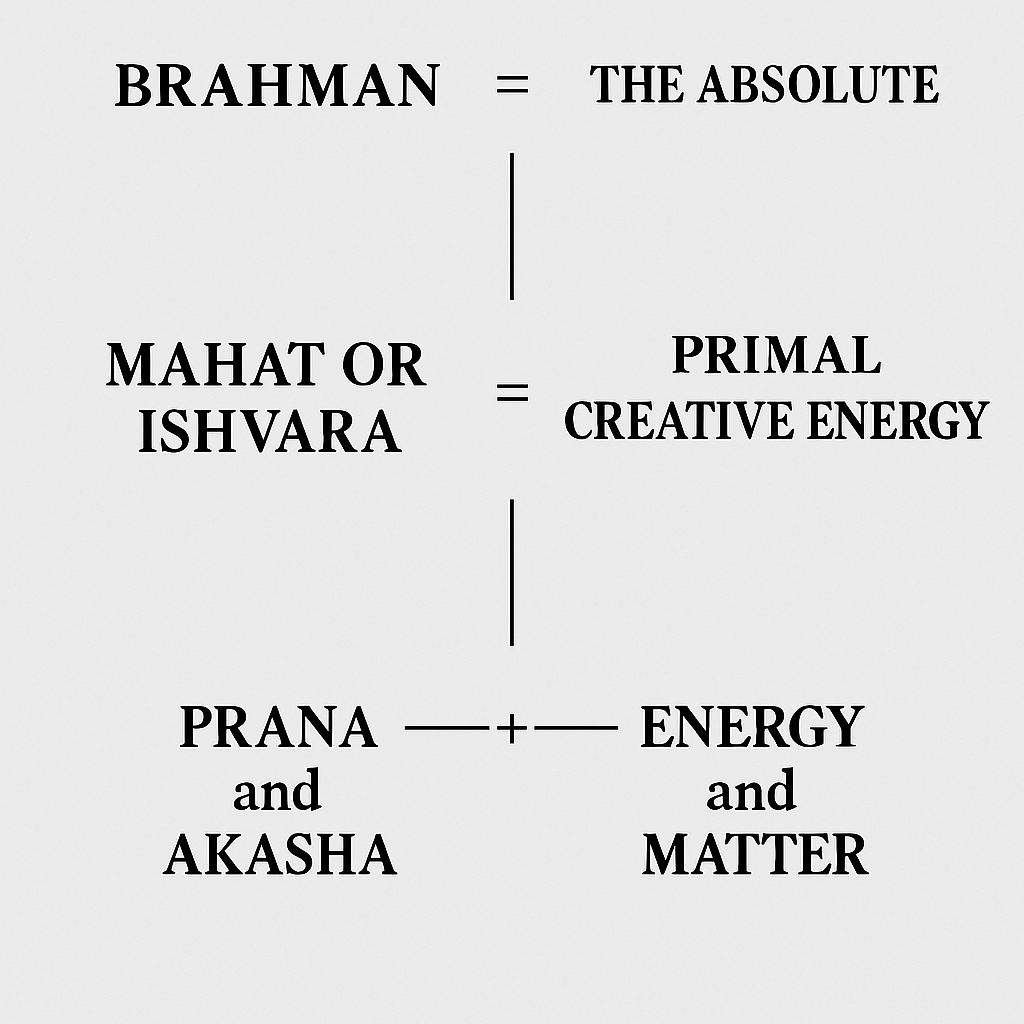
    In one of his letters, Swami Vivekananda even illustrated this idea with a diagram.


    He explained that from the Brahman, the Absolute Reality, emerges Mahat or Ishvara — the primal creative energy. From this Mahat manifest Prana (energy) and Akasha (matter), which together give birth to the entire cosmos.

    And he asked Nikola Tesla to mathematically prove this very theory of the Vedas — that force and matter, that is, Akasha Tattva, are reducible to energy.
    However, due to the misunderstanding of certain Sanskrit terms, Nikola Tesla was unable to mathematically prove this concept.

    Yet, shortly after, Tesla wrote an article titled “Man’s Greatest Achievement,” in which he echoed the same insight — describing how Prana and Akasha combine to create everything in the universe.

    Interestingly, Swami Vivekananda had already written something very similar in his book “Raja Yoga” (Chapter 3). He described how Akasha, the subtle element, manifests into gross form — the physical world we can see and touch — through the power of Prana.

    And just as Prana manifests the outer universe, the same Prana energy flows within us, manifesting as our thoughts.
    It is this very energy that the ancient sages learned to control through the practice of Pranayama — the art of mastering the life force.