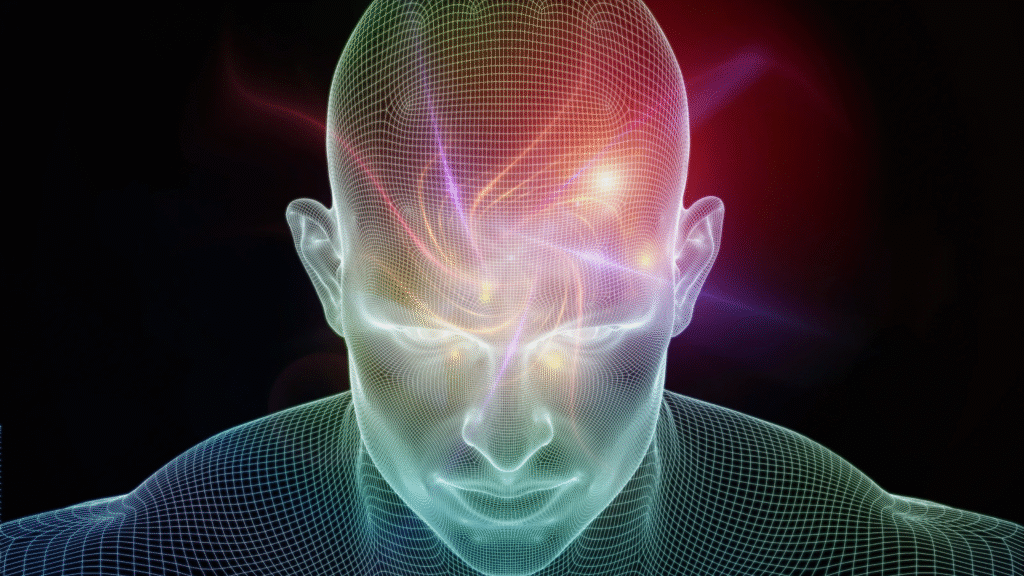
What is consciousness? And where does it originate from?
This is one of the most complex, mysterious, and unsolved puzzles of the world about which human beings have been trying to understand for thousands of years.
Science says that the human brain contains nearly 100 billion neurons, and these neurons form countless synaptic connections with one another. When these innumerable synaptic connections fire in a particular rhythm and pattern, consciousness arises in the brain. In other words, science claims that our brain itself creates our consciousness.
The Question Science Cannot Answer
When philosophers like David Chalmers ask scientists a crucial question “How do physical processes occurring in the brain give rise to a person’s subjective experience?”
Then scientists have no answer to David Chalmers question.
What this means is that with scientific instruments, we can certainly understand how the process of seeing works in the brain. But the experience that arises from that process such as:
The blueness of blue, The whiteness of white, Or the freshness of nature, cannot be explained by science.
That is why, even today, for science, consciousness remains a mystery.
Looking Beyond Science
When curious (jigyasu) people step outside the world of science and look further, many philosophies attempt to explain what consciousness is.
According to Evan Thompson’s book Waking, Dreaming, Being, the oldest and earliest answer to the question “What is consciousness?” is found in the Upanishads, which state “Anidam Chaitanyam.”
This Sanskrit phrase simply translates to “Not this” is called consciousness.
How Can “Not This” Be a Definition?
At this point, you might be wondering, How can ‘not this’ be a definition of consciousness?
The Upanishads explain it in this way anything which can be represented, labeled, or identified as “this” cannot be consciousness.
For example:
This pot, this body, this thought, this emotion. All these things can be objectified using the word “this.” Therefore, none of them can be consciousness.
Thoughts and Emotions Are Also “This”
With a little awareness and mindfulness, you can even identify which part of the brain a particular thought or emotion originates from. This means that thoughts and emotions can also be represented as “this”. But the moment you say in your mind, “This consciousness” the very next thought that arises asks: “Which consciousness?”
Try it right now. Say in your mind:
“This consciousness… this consciousness… this consciousness.”
No matter how hard you try, the more you attempt to grasp consciousness the more it slips away like sand through your fingers. And you fail to understand what consciousness is.
And yet, in your own direct experience you know very clearly that you are conscious.
Isn’t that amazing?
The Advaita Vedanta Perspective
Advaita Vedanta says that through the five senses
Sight, Sound, Smell, Taste, and Touch. We experience the world in different ways. But behind all these different experiences, the awareness is one and the same. And this single awareness is what Advaita Vedanta calls consciousness.
Consciousness as a Mirror
Advaita Vedanta says Consciousness is like a mirror and
our thoughts, emotions, and experiences are projected onto it. And Just as a mirror is not affected by the images or movements reflected in it, in the same way thoughts, emotions, and experiences keep changing in the brain but the awareness (Consciousness) behind them never changes.
Advaita Vedanta goes so far as to say that this entire world is merely a reflection in the mirror of consciousness.
Only consciousness, or Brahman, is the ultimate truth.
Everything else is an illusion—maya.
A Final Reflection
Consciousness is not something you can see. It is that through which everything is seen. That is why the most fundamental inquiry is not the question:
“What is consciousness?” But the deeper, more intimate question we are invited to ask is:
“Who am I?”
Not as a concept,
not as an identity,
but as a direct investigation into the one who is aware.


Leave a Reply to Improvement facts Cancel reply